
Table of Contents
Taking medication does not necessarily preclude obtaining an FAA medical certificate. Rather, it is about how the medication, dosage, side effects, interaction, and condition that caused the need for the medication will impact your ability to perform aviation duties safely. When looking at FAA disqualifying medications for pilots, it is imperative that one goes beyond just the medication name itself.
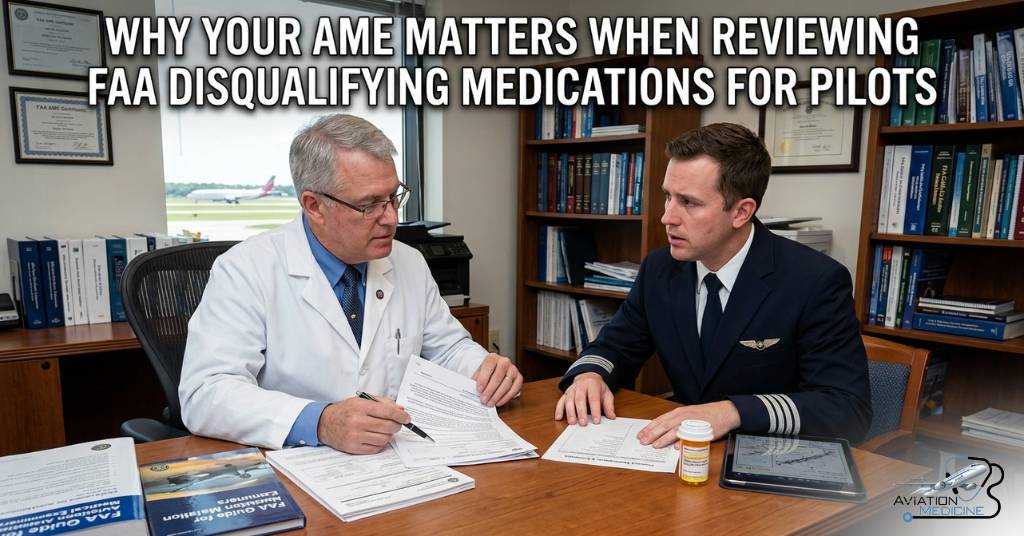
This is the reason why your Aviation Medical Examiner (AME) is vital. As per the FAA, aeromedical decisions involve the condition and treatment of the condition, and the medication references of the FAA are not entirely comprehensive.
Discussing medication concerns with an AME prior to starting or switching medication can prove helpful for pilots.
Why Your AME Matters in Medication Decisions
Your treating physician focuses on your health and choosing appropriate treatment. Your AME has an additional responsibility: considering that treatment from an aviation medical certification perspective.
The FAA has pointed out that the actual illness may have an equally important impact on certification compared to the drug. Thus, the AME may take into account the reasons for taking the drug, the dosage, the history of the treatment, side effects, any additional drugs taken by you, and the need for FAA clearance.
This is why the help of an Aviation Medical Examiner is far more valuable than just searching for medications.
Is There Really an FAA Banned Medications List?
Pilots tend to seek information regarding an FAA banned medication list, since they look for a simple yes or no answer. However, the FAA does offer some guidelines regarding certain medications and medication classes, although it makes it clear that its references are not entirely inclusive.
A particular medication cannot be evaluated solely based on itself. The FAA mentions several considerations which include the medical condition, dosage, interactions between drugs, combined treatments, and effects on the pilot’s performance.
So, if your prescription does not appear on a list, don’t automatically assume it is acceptable. Likewise, finding a medication in FAA guidance does not necessarily determine your individual certification outcome.
The better approach is to discuss the exact medication with your AME.
DNI vs. DNF: What Do They Mean?
Two terms you’ll encounter in FAA medication guidance are Do Not Issue (DNI) and Do Not Fly (DNF).
Term | What it means |
Do Not Issue (DNI) | The examiner should not issue the certificate without the required FAA clearance. |
Do Not Fly (DNF) | The medication may seriously affect pilot performance, so the pilot should not fly as advised. |
The FAA specifically directs examiners to its DNI/DNF guidance when medications may require clearance or could seriously degrade pilot performance.
A DNI situation does not necessarily mean permanent denial. It can mean that additional FAA review or clearance is needed.
Can I Fly With Blood Pressure Medication Under FAA Rules?
Blood pressure medication is a good example of why a general medication list isn’t enough.
The FAA provides specific guidance for antihypertensive medications. Depending on the drug and circumstances, certain medications may be acceptable for certification. There is an additional requirement set by the FAA to monitor pilots using some newly introduced hypertension medications.
Thus, if you are wondering about whether you can fly with high blood pressure medication according to FAA rules, this will depend on the exact type of drug that you have prescribed by your doctor.
The AME can evaluate your specific prescription rather than relying on a general internet answer.
G3 What About Antidepressants?
Antidepressants require the same kind of individualized attention because both the medication and the underlying psychiatric condition can affect certification.
The FAA includes antidepressants among the medication categories covered by its pharmaceutical guidance.
Finding FAA approved antidepressants for pilots may be a good beginning step for you, although this will not be sufficient. Your own diagnosis, experience of treatment, stabilization on medications, and reaction to treatment may become significant as well.
If anxiety is part of the concern, Can a Pilot Fly With Anxiety Under Medical Certification Rules in 2026? can provide additional context.
If you take an SSRI, ask whether FAA Special Issuance for SSRIs may apply to your circumstances. And don’t stop a prescribed medication simply because you are concerned about certification. Discuss any treatment change with your treating physician first.

Need Help With a Medication?
Get expert guidance from Dr. Auren Weinberg and the Aviation Medicine team on FAA medication requirements before your medical exam.
Which Medications Can Raise FAA Questions?
The FAA’s pharmaceutical guidance includes a myriad of drugs; antidepressant, antihypertensive, anti-coagulant, sedatives, sleep aids, controlled substance, insulin, allergy, and weight-loss drugs.
Sometimes such drugs may pose issues due to the health condition of the applicant and that is why knowing the top 10 disqualifying medical conditions for FAA medical certification could help you to understand how your treatment influences your ability to be certified.
The main point: Having problematic medication during an FAA medical evaluation does not necessarily mean that you are grounded for life.
Depending on the medication and circumstances, a pilot may face a temporary no-fly period, FAA clearance, additional documentation, or another certification pathway.
Talk to Your AME Before Starting Something New
One of the easiest mistakes to avoid is waiting until exam day to mention a new prescription.
The FAA tells pilots to discuss medication questions with their physician and AME. The FAA knows that doctors who don’t specialize in aviation medicine might not think about how a medication or condition affects flight safety.
Ask Before You Start
If your doctor suggests a new medication, ask:
- Could it affect my ability to fly?
- Is there a required no-fly period?
- Could FAA clearance be necessary?
- Will I need extra records?
- Should I talk to my AME before starting it?
Your doctor handles the medical side. Your AME explains the aviation certification side.
What Happens If FAA Review Is Needed?
A medication concern doesn’t automatically end your certification.
Depending on what’s going on, your AME might need to defer the decision or get FAA clearance. You might need extra medical records, treatment history, or other documentation.
If you’re getting ready for an FAA 2nd Class Medical Examiner appointment, organizing your medication history beforehand makes the review easier.
Come Prepared
You should know the name and dose of each medication you take, when treatment was initiated or changed, the reason for use of each medication and whether side effects occurred.
If your AME has requested medical records or previous FAA documentation, have those available as well.
How an AME Can Help Protect Your Aviation Career
Medication questions are way easier when you deal with them early.
An AME can help you understand whether a medication affects your flight status, whether you need extra documentation, and whether FAA review is appropriate.
For pilots looking at prescription medications, the same federal FAA certification requirements apply. A Florida AME can explain how those requirements apply to your specific situation.
If you’re looking for AME medication review Florida, working with an aviation medical professional who knows FAA requirements can help you tackle medication questions before your exam.
When Might HIMS Be Relevant?
HIMS is a specialized part of aviation medical certification, not just another name for a standard medication review.
Pilots dealing with substance or alcohol-related certification issues might encounter HIMS requirements and specialized monitoring. If that applies to you, the FAA HIMS Drug and Alcohol Program Florida might be more relevant than general medication guidance.
A HIMS Aviation Medical Examiner Florida can figure out if that pathway works for your situation.
Common Medication Mistakes to Avoid
A few medication mistakes can make an FAA medical review way more complicated. If you’re worried about FAA disqualifying medications for pilots, watch out for these common issues.
Assumption of Safety: Never assume that just because a medication is common or over the counter, it is always safe for use when flying.
Missing Ingredients: Check what’s actually in combination cold, allergy, and sleep medicines. A product might have a sedating ingredient you didn’t know was there.
Waiting Too Long: Talk to your AME about new medications before starting treatment or going back to flying. Early guidance prevents confusion.
Overlooking Side Effects: Do not travel by air immediately after trying out new medication. Take some time on the ground to observe the side effects.
Withdrawing Medication: Do not withdraw your prescribed medications due to fear of certification. Consult your physician before doing so.
Forgetting Changes: Keep your medication information current when prescriptions, dosages, or treatments change. Your AME needs the real picture.
Using Old Lists: Don’t rely on outdated online medication lists to decide if you can fly. FAA guidance isn’t complete, so talk to your AME about uncertain medications.
Skipping Restrictions: If FAA guidance requires a specific no-fly or observation period, follow it. Don’t go back to flying early just because you feel fine.
What If You’re Unsure About a Medication?
Start with your exact medication, dosage, and reason for treatment instead of looking for a simple yes or no.
Then check current FAA guidance and talk to your AME. Ask whether you need a waiting period, extra records, FAA clearance, or another certification step.
Most importantly: don’t change necessary medication just because of something you found online. Your regular doctor should guide the medical decision. Your AME explains the aviation certification side.
Pilot Medication Review Checklist
Before your next FAA medical examination, make sure you have:
- Current medication names and dosages
- Treatment start or change dates
- Prescribing physician information
- Relevant medical records
- Previous FAA documentation
- Information about side effects
- Questions ready for your AME
The goal isn’t memorizing every medication in the FAA Guide. It’s making sure your AME has accurate information about what you’re taking, why, and how it affects you.
Plan Your Medication Review Before Your FAA Medical
Memorizing the list of FAA disqualifying medications for pilots is not important. Rather, the FAA considers the medicine, the condition, the dosage, the drug interaction, and the possible effect on flight operation.
At Aviation Medicine, Dr. Auren Weinberg and his team provide FAA medical exams and aviation medicine consultations, including HIMS and Special Issuance support. For pilots researching FAA medical certificate prescription drugs Florida, professional guidance can clarify how FAA requirements apply to your situation.
Getting advice early helps you understand what documentation or next steps you need. If you’re unsure about a medication or preparing for an FAA medical, call (727) 648-2402 or email aweinberg@medavex.org to talk with the Aviation Medicine team.