
Table of Contents
Introduction
Getting ready to learn how to fly comes with plenty of new terms, forms, and requirements. One of the first things many new students wonder about is the medical examination.
An FAA student pilot medical exam is an important part of the process for student pilots who need medical certification for their planned flying privileges. The test will be administered by an FAA designated Aviation Medical Examiner (AME). The AME examines your medical record and does the testing.
For your first visit, you do not have to worry too much. Knowledge about what will take place in advance, what information you should provide, and what the AME may ask you can relieve a lot of stress.
What Is an FAA Student Pilot Medical Exam?
An FAA medical exam is not quite the same as a routine physical at your regular doctor’s office. It is an aviation-specific examination designed to determine whether you meet the medical standards for the certificate you are seeking.
For student pilots, the appropriate certificate depends on the type of flying and privileges they plan to pursue. A third-class medical certificate is commonly associated with student and private pilot operations, although your specific requirements depend on your circumstances.
The examination generally looks at areas such as:
- Medical history
- Vision
- Hearing
- Blood pressure
- Pulse
- Physical condition
- Current medications
- Relevant medical conditions
The goal is not simply to look for problems. The AME needs enough accurate information to make the appropriate medical certification determination.
Do Student Pilots Need an FAA Medical Certificate?
This is one of the first questions worth answering before you start flight training.
Whether you need a medical certificate depends on the type of flying and privileges you intend to exercise. Medical certification is particularly relevant when a student pilot is preparing for solo flight and progressing toward pilot certification.
There is also a practical reason to take care of this early.
If your medical history is straightforward, you may be able to complete the process without much extra work. If the AME needs records from a doctor or specialist, however, you may need additional time. If you’re also wondering how long does an FAA medical exam take, the appointment itself can vary depending on your individual circumstances.
For Medical certificate for aviation students requirements, it is better to understand what applies to your particular training plans before assuming you need a specific class of certificate.
What Happens During Your First FAA Medical Examination?
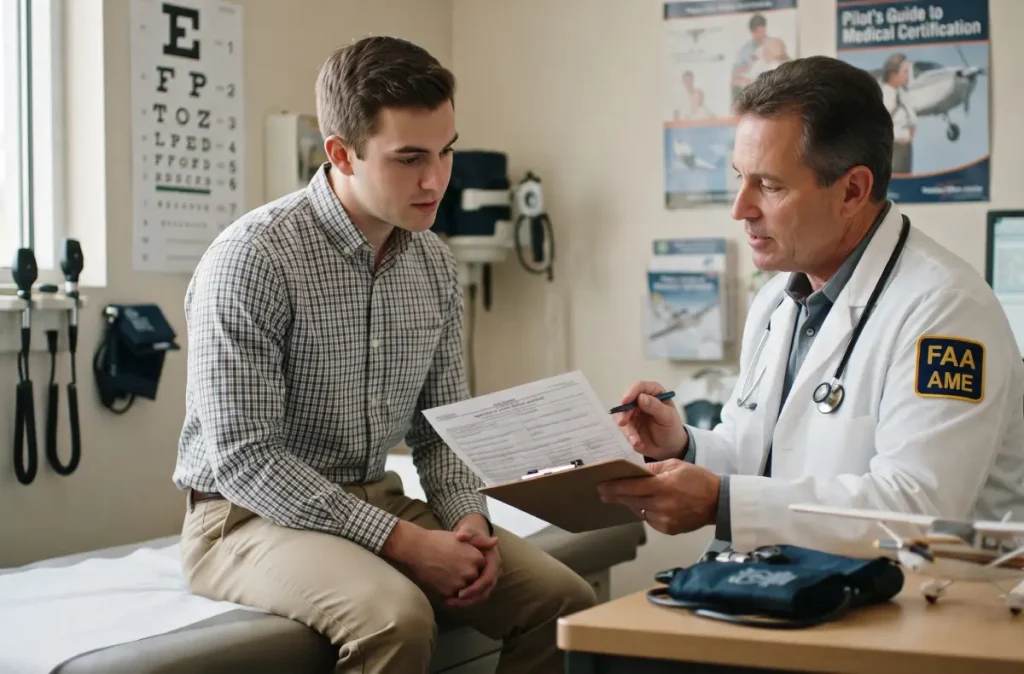
Your first visit will normally involve some paper work, questions, some preliminary tests and a physical exam.
Following are things that you should be expecting:
1. Medical history review
The AME will review information about your health, previous conditions, surgeries, medications, and other relevant medical history.
2. Vision and hearing checks
Your eyesight and hearing are evaluated according to the requirements applicable to the medical certificate you’re seeking. If you wear glasses or contacts, bring them with you.
3. Basic measurements
The examination can include measurements such as blood pressure and pulse.
4. Physical examination
The AME performs the physical portion of the examination required for FAA medical certification.
5. Review of your information
If something needs clarification, the AME may ask additional questions or request supporting records.
If you have been searching for FAA medical exam vision hearing requirements, these checks are simply part of the broader medical certification examination rather than separate appointments.
What Medical Information Should First-Time Applicants Bring?
Some preparation time can actually save you a lot of trouble at a later stage.
Instead of wondering about what to bring to your first AME appointment, quickly jot down everything the doctor needs to know about your medical history.
It helps to have:
- A current list of medications and dosages
- Relevant medical records
- Specialist information, if applicable
- Details of significant surgeries or previous treatment
- Glasses or contact lenses
- Previous FAA medical certification information, if applicable
You do not need to bring a lifetime’s worth of medical paperwork. Focus on information related to your present health condition and medical history.
The most important thing is for the information provided by you to be comprehensive and truthful. It is always better not to guess about any information that you do not remember.
What Medical Conditions Can Affect FAA Certification?
This is probably the part that worries applicants the most.
Having a medical condition does not automatically tell you what the outcome of your examination will be. The AME considers the condition, your current health, treatment, medical history, and any supporting documentation that may be needed.
Some medical conditions may require additional review. In such situations, the AME will request records from your treating physician or specialist prior to finishing the process of certification.
Therefore, instead of wondering, “Will this diagnosis disqualify me?”, it would be much better to wonder about, “What will AME require from me to consider my case?”.
When you have a complicated or serious medical background, prior discussion of your case with an FAA Aviation Medical Examiner could give you some tips on how to prepare.
What If You Take Prescription Medication?
Being prescribed certain medications is not the reason not to get your FAA medical certificate. In fact, during the examination, the AME will ask you why you are prescribed this drug, how long you have taken it, was there any change in dosage, do you have any side effects which might prevent you from safe flying.
Stay updated with your medications. Especially when you start taking something new or stop taking one drug and start another. The most important rule is never to stop taking prescribed drugs just because of an upcoming FAA exam. Any changes to your treatment should be discussed with the physician managing your care.
What Happens If the AME Needs More Medical Information?
Sometimes an AME has enough information to complete the examination immediately. Other times, something in your medical history needs a closer look.
You may be asked to provide:
- A specialist’s report
- Hospital records
- Previous treatment notes
- Test results
- Additional information about a medical condition
It may be frustrating at times considering the fact that you had intended to take care of everything in one visit. Nevertheless, the additional request for records does not mean that obtaining the certification is impossible.
The most important thing you can do is to find out what exactly is required from you and provide this information. Preparing the appropriate documents ahead of time will make things much simpler.
Heading to Your First AME Appointment?
A little preparation can save time later. Dr. Weinberg and the Aviation Medicine team can help you understand what to bring and what to expect during your FAA medical evaluation.
How Should First-Time Applicants Prepare for the Exam?
You don’t need a complicated preparation routine. A simple checklist is enough.
Before your appointment:
Complete your MedXPress information carefully.
The FAA MedXPress application procedure is an essential step in preparation for your medical exam. Double-check your answers prior to submitting your application.
Create a medication list.
List down medications along with dosage rather than depending on your memory.
Check your medical history.
Remember past diagnoses, surgeries, and hospitalizations.
Gather important records.
If you already know that a condition may require supporting documentation, start collecting it before the appointment.
Bring your vision correction.
Remember to take your glasses or lenses if you wear them regularly.
A quick and easy third class medical exam checklist will make sure you have covered all the basics without having to make things complicated for yourself.
Common Mistakes First-Time Applicants Should Avoid
First-time applicants rarely make major mistakes. Usually, it is something small that creates unnecessary delays.
Watch out for these common issues:
- Forgetting medication names or dosages
- Leaving out relevant medical history
- Arriving without requested records
- Waiting until the appointment to contact a specialist
- Assuming a diagnosis automatically means you cannot be certified
- Guessing when you are unsure about a medical detail
One of the easiest ways to avoid problems is to slow down when completing your forms. Read each question carefully and make sure your answers match your actual medical history.
What Happens After the FAA Medical Exam?
There isn’t one outcome for every applicant.
Depending on your examination and medical history, the AME may:
- Issue your medical certificate
- Request additional information
- Defer the application for further FAA review
If additional information is requested, follow the instructions and provide the required records. A HIMS Aviation Medical Examiner Florida may also be relevant for applicants who require specialized medical certification support.
Applicants sometimes ask, can you fail your first FAA medical exam? The outcome depends on the individual circumstances and applicable FAA medical standards.
When Should You Schedule Your FAA Medical Exam?
If you already know that you want to start flight training, getting your medical examination done early can be a smart move.
Why?
Because it gives you time to deal with anything unexpected.
A straightforward examination may be completed without much delay. But if your AME needs medical records, specialist information, or additional FAA review, you will have more time to handle those steps without putting unnecessary pressure on your training schedule.
This is especially worth considering if you have a significant medical history.
Key Takeaways
The process of going through your first FAA physical exam should not be something that you dread. The majority of the anxiety usually stems from the unknown.
Before your appointment:
- Know which medical certificate fits your flying goals.
- Complete your FAA paperwork accurately.
- Prepare your medication list.
- Gather relevant medical records.
- Bring your glasses or contacts if needed.
- Be honest and complete about your medical history.
- Give yourself enough time for possible additional review.
A little preparation can make the appointment much more straightforward.
Understanding Your FAA Medical Certification Options
Getting your medical certification is an important early step in your aviation journey. The requirements depend on the certificate and flying privileges you plan to pursue. If you have questions regarding your medical history and what you should prepare to bring, an FAA 3rd Class Medical Examiner can assist you with that.
For individuals with a complex medical history, scheduling a discussion with an AME before your flight medical can prevent any problems and save your time. Aviation Medicine, headed by Dr. Weinberg, offers aviation-related medical exams and advice for pilots going through the process of FAA certification. You can reach out to Dr. Weinberg at aweinberg@medavex.org or (727) 648-2402.
The preparation of all medical paperwork beforehand will reduce your stress level and give you more time to learn how to fly.