
Table of Contents
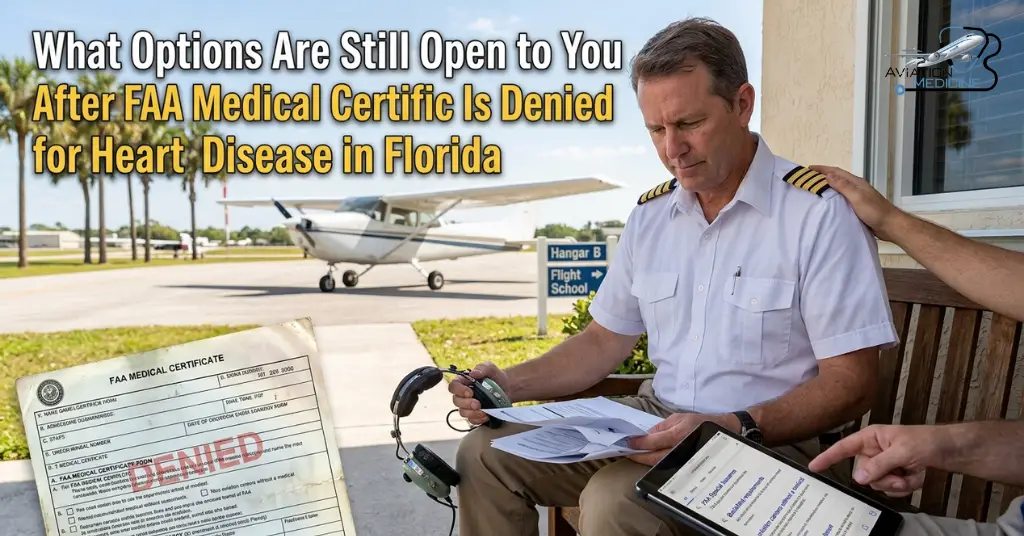
Getting that denial letter feels like the end of something. Maybe you’ve been flying for years, or you just finished your training this summer and were about to start logging real hours. Either way, opening a letter that says your FAA medical certificate is denied because of a heart condition lands hard. It’s natural to assume that’s it: career over, hobby over, done.
It’s usually not. Many pilots with qualifying heart conditions are later able to obtain certification through the FAA’s Special Issuance process. The process takes patience and the right paperwork, but plenty of pilots with real cardiac history are flying again within a year of their initial denial.
Here’s what actually happens after a denial, and what paths are still open to you.
Deferral vs Denial
This trips people up constantly, and it matters a lot for what happens next.
Deferral | Denial | |
What it means | Your AME couldn’t make the call and sent your case to the FAA for review | The FAA reviewed your case and formally said no |
Who decides | FAA Aerospace Medical Certification Division | FAA Aerospace Medical Certification Division |
Can you fly while waiting | No, not under that application | No |
Next step | Wait for FAA decision, may request more records | Apply for special issuance or appeal |
How common | Very common for any complex cardiac history | Less common than deferral, but does happen |
FAA medical deferral vs denial confuses a lot of pilots because both feel like bad news at the moment.A deferral isn’t a denial. It means the FAA needs additional time and documentation before making a certification decision. A denial is the actual decision, and it’s the point where special issuance becomes the real path forward.
FAA Medical Certificate Denied & What Should You Do First
If you’ve gotten the denial letter, here’s the practical order of operations:
- Read the denial letter carefully. It should specify the exact reason and what documentation, if any, would support reconsideration
- Gather your complete cardiac records: every test, every visit, every treatment note related to the condition
- Talk to your cardiologist about getting current, detailed documentation specific to FAA requirements
- Consult with an AME experienced in special issuance, ideally one with HIMS training
- Decide whether to pursue special issuance or appeal the decision
- Submit a complete, well-documented application. Incomplete submissions are the number one cause of delays
This isn’t a process to handle alone if you can avoid it. The paperwork requirements are specific, and missing a single piece of documentation can add months to an already lengthy timeline. An experienced Aviation Medical Examiner can help identify missing documentation before your case is submitted to the FAA.

Denied an FAA Medical for a Heart Condition
Get experienced guidance on the FAA special issuance process and your next steps.
What Heart Conditions Commonly Lead to Denial
Not every cardiac issue results in denial, but certain conditions trigger more scrutiny than others:
- Coronary artery disease requiring stents or bypass surgery
- History of myocardial infarction (heart attack)
- Significant arrhythmias, including atrial fibrillation
- Cardiomyopathy
- Valve replacement or repair
- Pacemaker or defibrillator implantation
- Uncontrolled hypertension with end-organ effects
Many of these conditions have an established special issuance pathway with the FAA meaning pilots have successfully returned to flying with proper documentation and monitoring. The key word is “established.” The FAA has seen these cases before, which actually works in your favor when you provide what they’re looking for.
How to Apply for FAA Special Issuance
Special issuance is the formal process that allows the FAA to grant a medical certificate despite a disqualifying condition, based on documented evidence that the condition is stable and controlled.
General requirements typically include:
- A detailed cardiology report, often including stress testing and echocardiogram results
- Documentation of how long the condition has been stable
- A statement from your treating cardiologist addressing your fitness to fly
- Any relevant cardiac event history, fully documented
- Current medication list and how it’s being managed
- In some cases, additional specialist evaluation requested directly by the FAA
The FAA reviews this package and, if satisfied, issues what’s called an Authorization for Special Issuance of a Medical Certificate. This authorization typically comes with a defined renewal schedule, meaning ongoing monitoring and periodic re-documentation, not a one-time approval that lasts forever.
Understanding the FAA Medical Special Issuance process early can help you gather the right records before submitting your application.
HIMS AME Special Issuance Process
Not every AME has experience guiding pilots through complex special issuance cases. A HIMS AME special issuance process specifically refers to examiners trained through the FAA’s Human Intervention Motivation Study program, which was originally developed for substance-related cases but has expanded into broader special issuance expertise, including cardiac cases.
Working with a HIMS Aviation Medical Examiner Florida pilots trust can make the special issuance process much easier to navigate, especially after a denial.
Why working with a HIMS-trained AME helps:
- They understand exactly what documentation the FAA’s cardiology consultants want to see
- They can flag missing pieces before submission, rather than after a rejection
- They have direct experience navigating the back-and-forth that often happens during review
- They can advise honestly on your odds and timeline based on similar cases they’ve handled
This matters because a poorly prepared special issuance package may result in additional FAA information requests, delays, or, in some cases, a denial if required documentation is not provided.
Appealing an FAA Medical Certificate Denial
If you believe the denial was made in error, or if new information has emerged since the original decision, appeal is a separate path from special issuance, though the two sometimes overlap.
Steps for appealing FAA medical certificate denial:
- Review the specific regulatory basis cited in your denial letter
- Gather any new or overlooked medical evidence
- Submit a formal request for reconsideration to the FAA’s Aerospace Medical Certification Division
- In more complex cases, legal counsel specializing in aviation medical law may be worth consulting
- If reconsideration fails, further appeal options exist through the NTSB, though this is a longer and more formal legal process
Appeals tend to make more sense when there’s a genuine dispute about the facts or the FAA’s interpretation, rather than when the underlying medical condition simply needs more time to stabilize and document, in which case special issuance is usually the faster, more direct route.
How Long Does the Process Actually Take
Stage | Typical Timeframe |
Initial deferral review | 60–120 days |
Special issuance application review (complete package) | 60–90 days |
Special issuance application review (incomplete package) | 6+ months, sometimes longer |
Appeal process | Several months to over a year |
The single biggest factor in the timeline is completeness. A thorough, well-organized application the first time around moves significantly faster than one that gets bounced back for missing information.
Can You Fly While Waiting
No. While your special issuance application or appeal is pending, you cannot exercise pilot privileges requiring a medical certificate. This is one of the harder parts of the process emotionally, the waiting happens in real time while your certificate status remains denied.
Some pilots in this position continue ground school, simulator training, or other aviation-related activities that don’t require an active medical certificate, just to stay engaged with flying during the wait.
Florida Pilots and Special Issuance
Florida has a large general aviation population, and AMEs across the state see cardiac special issuance cases regularly, it’s not an unusual or rare situation for pilots based here. What matters most isn’t your location, though, it’s finding an AME who specifically has experience with these cases rather than someone who handles them occasionally.
Know more about Denied FAA Medical? Florida AME Shares Steps for Special Issuance Appeal.
FAQs
What is the difference between an FAA medical deferral and a denial?
How long does the FAA special issuance process take?
Can a HIMS AME help me after my FAA medical is denied?
Can I still fly while waiting for FAA special issuance approval?
How do I appeal a denied FAA medical certificate?
Work With Someone Who Knows This Process
Getting an FAA medical certificate denied for heart disease isn’t the end of the story for most pilots, it’s usually the start of a documentation process that, done right, leads back to the cockpit. Aviation Medicine, led by Dr. Auren Weinberg, a HIMS-trained Senior AME with over 25 years of medical experience, helps pilots in Florida navigate exactly this kind of case.
📞 Contact Aviation Medicine today at (727) 648-2402 or email us at aweinberg@medavex.org to talk through your situation and your next steps.